
As a sort of “companion piece” to my recent post on highlighting too many things, here’s more hard-won advice about underlining and bolding in your fundraising:
The words you highlight should be understandable without reading the whole piece.
Here’s what I mean. The following is a screenshot of a story I recently reviewed for a print newsletter. Focus on the bolded copy:
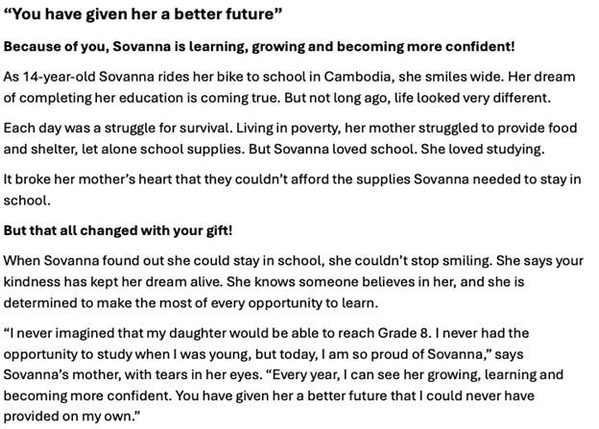
If you only reading the headline, subhead and emphasized copy (which is all than an estimated 80% of people read), you will receive the following message:
- You have given her a better future
- Because of you, Sovanna is learning, growing and becoming more confident
- But that all changed with your gift
What does the last sentence mean? What all changed? I thought Sovanna was doing great, but I guess she’s not doing great any longer? And I caused that?
The reader doesn’t know what the sentence means, and it possibly changes the meaning of the whole story. That is a big problem if the emphasized copy is the only thing a donor reads – which is true for most donors!
Now, contrast that to my edited version:

Now look at the three things a “scanner” would take away:
- You have given her a better future
- Sovanna’s Mom is going to tell you how much you improved her daughter’s life
- You provided a backpack, notebooks and other school supplies that Sovanna needed.
I made a handful of changes, but the change I want to focus your attention on is the bolded sentence in the middle of the story. We went from a sentence the donor doesn’t understand (she doesn’t know what the word “that” refers to), and the donor doesn’t know if the change was good or bad – to a sentence that clearly tells the donor the concrete things that happened because she gave.
When you’re choosing what to bold or underline, always check for two things:
- The words or sentence must be understandable even if the donor hasn’t read the rest of the piece. Watch out for pronouns that reference sentences that the donor likely hasn’t seen! The word “that” in the original is a perfect example of this.
- The bolded or underlined copy, taken together, should tell a coherent story.
Always always always remember that most donors will scan before they read. And many donors will only scan and never read.
Learn to write and emphasize your fundraising to make sense to scanners. When you do, you dramatically increase the number of people who will receive the message you’re trying to send.

Steven Screen is Co-Founder of The Better Fundraising Company and lead author of its blog. With over 30 years' fundraising experience, he gets energized by helping organizations understand how they can raise more money. He’s a second-generation fundraiser, a past winner of the Direct Mail Package of the Year, and data-driven.
- Steven Screen

- Steven Screen

- Steven Screen

- Steven Screen