The Donor Story You’re Probably Ignoring (and Losing Money By Doing It)

Clean data.

The following is a hand-picked guest post from Clay Buck. Enjoy, and you can read more about Clay below.

***

Let’s play a quick game.

Which of these would you trust more?

  • An AI navigator that says, “Turn left now,” just as you drive into a lake. 
  • Or a paper map from 1993 that at least *tries* to tell the truth.

If your donor database isn’t clean, your fundraising is doing the same thing as that navigator: confidently giving bad directions. And that’s not just annoying – it’s expensive.

So let’s talk about something most fundraisers don’t get super excited about: data hygiene.

Yes, I know. It’s not flashy. It doesn’t come with confetti or applause. But keeping your donor data clean and up-to-date might be the single most important thing you do to raise more money.

Let me show you why.

Why Dirty Data Is Costing You Money

Picture this: you spend hours writing a beautiful appeal letter. You print it on nice paper. You add a lovely reply card and envelope. You fold it all perfectly and send it out with hope and a postage stamp.

And it gets returned because the address was wrong.

Or worse – it goes to the wrong person entirely. Or uses the wrong name. (“Dear Occupant” never exactly tugs the heartstrings.)

Every returned letter is wasted money. Every wrong name is a little nick in your donor’s trust. And every outdated email or phone number is a missed chance to connect.

It adds up fast. Some studies estimate that the average nonprofit loses 8-10% of its fundraising revenue to bad data.

That’s money you could be spending on programs. On salaries. On stamps that *actually* reach people.

That’s time you or your team are spending editing and cleaning data on the fly – time that could be much better spent scrounging the breakroom for leftovers.  (Or, you know, writing those thank you notes you haven’t had time to get to.)

What Do We Mean by “Clean Data”?

Clean data just means this: 

  • It’s accurate.
  • It’s up to date.
  • It’s complete enough to do your job well.

That’s it.

You don’t need a PhD in database wizardry. You just need to make sure the basics are solid:

  • People’s names are spelled correctly
  • Addresses are current
  • Emails work 
  • Gifts are recorded in the right place
  • Notes are consistent

Think of your database like a campfire. Your donors gather around it to support your cause – and they’ve shared some of their stories to keep the fire burning. Their address? That’s a breadcrumb of who they are. Their giving history? A reflection of what matters to them. Every piece of data is a detail they’ve chosen to share.

We talk a lot about the stories we *tell* our donors. But data? That’s how they tell *their* stories to us.

So if our data is messy, we’re not just making our jobs harder – we’re ignoring their story.  And betraying their trust.

Clean Data Builds Trust

Let’s say you send a thank-you letter, and it includes:

“Dear Sarah, thank you for your $100 gift made on February 28 toward our literacy program. You’ve made a real difference in helping kids learn to read.”

Sarah will feel seen, valued, and appreciated.

Now imagine that same letter said:

“Dear Supporter, thank you for your gift. You are helping.”

Sarah’s checking her watch and wondering if you even noticed her at all.

When your data is clean, you can personalize every message. And personalized messages build relationships.

And relationships? They’re what fundraising is *actually* all about.

The ROI of Clean Data (a.k.a. The Math That’ll Blow Your Mind)

Let’s talk numbers – and I promise, no calculator required.

Say you have a list of 1,000 donors. Over the course of a year, they give a combined total of $100,000. That’s an average of $100 per donor.

Now let’s say 10% of that data is bad. Maybe the addresses are outdated, the emails bounce, or the names are wrong. That’s 100 donors you can’t reach.

And if you can’t reach them, you can’t raise money from them.

So, 100 donors x $100 each = $10,000 in lost revenue. Just because your data wasn’t clean.

But it doesn’t stop there.

Next year, those 100 donors are still missing. And maybe another 10% drop off. Now you’ve lost another $10,000.

That’s $20,000 in lost potential. 
And the next year? $30,000. 
It *compounds* – like interest, but backwards.

You’re not just losing money once. You’re losing it over and over again, every year that donor can’t be contacted, can’t be thanked, can’t be invited to give again.

This is the hidden cost of bad data. And it’s real.

On the flip side? Clean your data, and you’re not just raising more money today – you’re building a stronger base for next year, and the year after that.

Common Excuses – And Why They Don’t Hold Up

“I don’t have time.” 
You also don’t have time to keep redoing mailings that bounce. Or to fix angry donor calls. Or to spend hours searching for info you *should* have at your fingertips.  Or finding new-and-theoretically-‘better’ donors.

“I’m not good with tech.” 
Good news: data hygiene isn’t about knowing all the buttons. It’s about habits. Like checking addresses when donors call. Or confirming names before merging lists. You don’t need to be fancy. You just need to be consistent.

“It’s not my job.” 
Actually, it is. If you’re a fundraiser, your job is to connect with donors – and that only works when the data behind the scenes is solid.

Think of your database like your kitchen. You don’t have to love scrubbing it, but if it’s full of crumbs and sticky spots, cooking’s going to be a lot harder.

Easy Wins to Clean Up Your Data

  1. Use a consistent naming format. 
  2. Verify addresses annually. 
  3. Remove duplicates. 
  4. Check bounced emails. 
  5. Log every interaction. 
  6. Make it someone’s job
  7. Run regular cleaning and appends like NCOA, de-duplications, standardization, phone and email validation, etc.  (Shameless plug, if you need help with this, Next River Fundraising Strategies can help.  It’s quick, relatively painless and, honestly, a lot less expensive than you think.)

Bonus tip? Turn it into a game: once a month, see who can find and fix the most errors. Winner gets coffee. Loser still gets clean data.

A Final Word (With Feeling)

You don’t need to love spreadsheets.

You don’t need to know all the tech.

But if you care about your mission – if you care about your donors – then keeping your data clean is one of the best things you can do.

It’s how you make sure your messages land. 
It’s how you show people they matter. 
It’s how you raise more money, more consistently, with less stress.

And maybe most importantly – it’s how you show your donors that you’re listening. That their story matters. That the data they’ve shared with you is being cared for, protected, and used with purpose.

Clean data isn’t just tidy.

It’s powerful. 
It’s personal. 
And it pays off.

***

Steven says, “Clay is the founder and principal of Next River Fundraising Strategies, creator of the Fundraiser’s Planner, and co-host of the #1 ranked fundraising podcast Fundraising is Funny. He’s a wide-eyed optimist about the power of generosity to change the world and focuses primarily on individual giving, strategic planning, and building the systems and storytelling that support and empower successful, ethical fundraising.”

Is Your Charity ‘Age-aware’?

Young donor.

The following is a hand-picked guest post from Tom Ahern. Enjoy, and you can read more about Tom below.

* * *

“We need younger donors!” Yes? No? Ummmm…?

What could possibly go wrong?

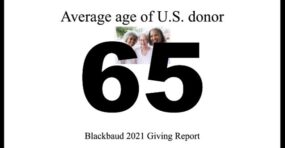
Three factors to consider: (1) most giving in the US comes from older people (for a mundane reason that co-exists with, but is not driven by, compassion); (2) charity leadership might not be aware of this; (3) have you heard of Dr. Ken Dychtwald?

——

Who gives (really)?

This is American data… and I don’t mean to be US-centric. But it doesn’t shift all that much across the English-speaking world, is my understanding. I’ve been loosely tracking it (via real experts) for more than 2 decades.

All I want is a solid mountain of data to climb… and Blackbaud has one.

What you often hear from well-meaning, really-trying-to-be-helpful board members, bosses, program staff and others is this:

“We NEED younger donors!”

Sounds like a reasonable strategy?

Or IS it? (Cue dramatic music.)

To my flimsy knowledge (raise your hand if, like me, you’re NOT a credentialed researcher): NO.

Au contraire: it’s an untutored, uneconomic, unrealistic, ill-advised strategy. A bright idea. A pillow dream. A “just add water” solution that sounds good until a charity attempts to execute it and meet its budget.

Dear sensible nonprofits…

There’s a sound economic reason you SHOULD chase OLDER donors: it’s about the money.

People AGE into their PRIME giving years.

Those donors who will prove most lucrative AGE into their “Now, I have more disposable income to give away” years.

That happy life-event happens around age 55, after other big-ticket items have been bought. According to the Wall Street Journal in 2022, “it now costs $300,000 to raise a child” through high school graduation.

Around 55, those who are “philanthropically-inclined” can START to give more to their favorite charities.

NOW… at long last… hallelujah [skip the ads]…  these age 55+ individuals / households finally have enough extra income to throw at beloved good causes, the ones their hearts always yearned to support.

——

Who’s Dr. Dychtwald?

Here’s a 2022 YouTube intro to psychologist and futurist Ken Dychtwald’s studies and conclusions. It’s about 5.5 minutes long. And, trust me, it will BLOW YOUR MIND (to revert to the phrasing of my youth).

His last name is pronounced “Dyke Wald,” BTW. And I want to thank Sallie Mitchell for reminding me of his insights and wisdom. She’s worked with Ken. And Sallie’s always been an enviable over-achiever “who gets sh*t done.”

When you’re younger, you’re building your life.

Except for some dot.com baby millionaires, you’re likely spending what you’re earning.

Of course, you’re intrinsically generous.

Maybe you were brought up that way. Maybe it’s baked into your core values. After all… major faiths around the planet command that you help others who are worse off.

So you WANT to help.

You CRAVE helping. Maybe you have passion and some time to spare, so you volunteer.

But surplus cash for young adults can be lean… and far between. I fed on food stamps for a decade after I hauled in my MA from an Ivy League school. I was white (privilege). I was male (privilege). I had parents who insisted I get a college education (privilege). And I was broke.

Eventually, lucky me, all that unearned privilege worked in my favor. Today is different than then. I escaped curbside doom. To my shock, I’m no longer poor. Destitute. Abandoned. Lucky me. Thanks to SO many others. I’m VERY lucky…

One more time: you – blessed, lovingly privileged – age into your prime giving years.

You become a force for good.

THE UN-BITTER TRUTH: Many people are generous beyond all reason… at all ages.

But until you have surplus income (after you’ve bought and built your life), you probably can’t give away all that much.

That happens around age 55, experts like Jeff Brooks concur.

——

STILL not convinced?

IF you’re buying the coffee (though I’d prefer cocktails) – I’m delighted to explain in greater detail (with PowerPoint and a dump-truck of world-sourced evidence) the undeniable economic realities re: why younger donors are not the Grail, the Golden Goose, the Miracle Whip, the Lottery, the Secret Sauce, the donor Magic, my father’s Leprechaun (he had one), nor the Easy Solution.

Fundraising is hard.

Don’t trust anyone peddling a glib financial solution like, “We need younger donors.”

At least not on the assumption that a donor acquired in her 20s will still be giving to the same causes in her 70s (the CDC’s birth-to-death lifespan is currently 76 years).

Why?

Because the average donor to the average charity doesn’t stick around that long.

Sure, some truest of true believers give for 30 years and even in their wills.

But… most give to a new-to-them charity for something like 4-6 years at best (annual donors) or 4-8 years at best (monthly donors), according to a poll I ran past top agencies globally.

All those agencies are data geeks. They hemmed and hawed. But in the end they confessed that most new donors do not stick around that long… and that’s WHEN you’re doing a GREAT job of donor cultivation (which few charities do).

Here’s the biggest kick in the pants for many charities: MOST (7-to-8 out of 10) FIRST-time donors do NOT make a SECOND gift. (Which is another great reason to promote monthly giving: it automatically cures that “second gift” collapse.)

To harp (I’m of Irish descent; I have the right; we all have harps): Fundraising is hard.

There are no easy solutions. Guessing doesn’t help at all. Know the data. Know what you’re up against.

Here are three data sources I lean on year after year, to set expectations for myself and clients (some unicorns were killed [or at least made tearful] in the making of this reality check):

Blackbaud Institute (a vast donor sample)
Giving USA (what’s happening in America)
M+R Benchmarks (digital/online fundraising)

* * *

Steven says, “Tom Ahern was described by the New York Times as “…one of the country’s most sought-after creators of fundraising messages.”  Tom has what I’d call the industry-leading newsletter about fundraising.  Being mentioned in it was a career highlight for me.  You can (and should!) subscribe for free here.”

ABCD

data

Always Be Collecting Data.

On your journey as a fundraiser, always be on the lookout for little bits of data to save.

Here are just a handful of data points I’ve collected over the years, all a result of head-to-head tests…

  • Thanking donors at the beginning of an e-appeal caused fewer of them to give.
  • Putting gift ask amounts in ascending order caused people to give more.
  • Removing distractions from a giving page caused increased conversion.
  • Adding a “faux reply card” to the back of a printed newsletter caused a 15% increase in net revenue.

Collect a bunch of little data points like these and you’ll develop what I’d call “fundraising intuition.” But it’s intuition trained with data, not personal opinions.

It helps you make decisions with high likelihood of success.

It makes you valuable because when people ask for your opinion they’ll receive evidence-based answers, not feelings.

Always Be Collecting Data.

You Need to *Not* Do Some Things in 2019

<Other

This month we’re posting about the fundraising strategies and tactics that worked well in 2018.

Here’s a piece of hard-won advice: if you want to raise more this year, you need to actively decide not to do some of the things you’ve done in previous years.

Here’s this strategy in a catchy quote:

All strategy is sacrifice.

And here’s how I explain this in a simple decision tree:

  1. You have limited resources (time and money)
  2. You have to decide what to do with your time and money
  3. Which means you also have to decide what not to do with your time and money.

Smaller nonprofits, in my experience, are bad at deciding what not to do. Specifically…

Smaller Nonprofits Have a Hard Time Stopping Doing Things

They have a harder time cutting projects and strategies that are no longer the highest use of limited resources.

I suspect this is mostly because of the collaborative nature of fundraising and communications in small- to medium-sized nonprofits. There’s always somebody who values a thing you’ve done in the past. Here are some recognizable examples:

  • You keep mailing printed annual reports to all donors because some board member or major donor rep says that they simply must have it.
  • You keep doing an event that loses money each year (not to mention the investment of time) because a major donor loves it and has made it their pet project.
  • You write, format and send out an e-newsletter every month because “we have to tell people what we’ve been doing” even though 1 out of 20 people actually open the email.

Sound familiar? And in a collaborative environment, it’s hard to tell stakeholders that their project is going to be cut.

It’s especially hard when the fundraising that’s actually raising the money (and keeping your donors) isn’t well-measured. Because when no one can point to a line on a spreadsheet and say, “Look, THIS is where we raise most of our money, we should do more of this” … then all projects are equal.

And when all projects are equal, the stakeholder with the loudest voice / most passion / highest ranking wins.

Your Nonprofit Needs to Make Hard Choices

Here’s my advice in a nutshell:

Measure and track what really produces your fundraising net revenue.

Then relentlessly focus your resources on doing more of those things.

Be willing to endure some interpersonal conflict in exchange for raising more money and doing more good.

There’s no silver bullet here. For most nonprofits it’s about making hard choices, measuring, and being “sold out” to doing more good – instead of doing what someone thinks is best.

If This Is Your Organization and You Want to Change…

We have one piece of advice for you: measure your fundraising inputs and outputs.

If you don’t already know, figure out how much everything costs and how much everything raises. That’s your preparation for starting the hard conversations.

Data doesn’t always win, but it sure helps. And the practice of gathering and evaluating data is a skill that is incredibly valuable in the nonprofit world.

Final Days of the Sale

Our sale ends in a few days! You can raise more money in 2019, and have more time to focus on important projects, by having Better Fundraising create your appeals, e-appeals and newsletters.

And you can save thousands of dollars.

Visit this page to learn more and fill out a simple form if you’re interested. We’re genuinely excited about how 2018 went for our clients, and would love to work with you in 2019!