If You Really Want to Acquire More New Donors, Read This

Make “The Leap” to Acquire a LOT of new donors

We’ve been asked a LOT lately about acquiring new donors.  (I don’t think this is a coincidence given that the number of individual donors in the U.S. decreased last year.)

If you want to learn about how bigger nonprofits acquire significant numbers of new donors every year, please take a look at the blog post below.  I wrote it in 2018 and every word is still relevant. 

Spoiler alert: there is no silver bullet.  There’s a skill you have to learn.  But the path is knowable.  And the great news is that lots of nonprofits have gone on the path before and will gladly share what they’ve learned to help you.

Happy reading!


This post is about acquiring new donors.

But it’s for nonprofits at a very specific stage in their development.

Keep reading if the following three things are true for your organization:

  • You’re actively trying to grow
  • You realize that to achieve that growth you need more new donors each year than you’ve been acquiring
  • You know that your current ways of acquiring new donors won’t achieve your new goals

I’ll give you an example. We work with a handful of organizations that have between 500 and 4,000 donors. These organizations want to grow… but the ways they acquire new donors are labor-intensive and are hard to expand:

  • Tours of their facility
  • An event or two a year
  • Word of mouth
  • A major donor connects them to another major donor
  • Vision Meetings

All good things – but small nonprofits can only do so many of them each year.

So the organization is stuck: they want to grow, know they need more donors, but don’t have the staff to do more.

If That’s You, What Do You Do?

If that’s you, please know that you’re in good company. A LOT of organizations are in your shoes.

But your question remains: how do you begin to acquire significantly more new donors than you have in the past?

It starts with thinking differently about acquiring donors. The Big Idea is that there is a cost associated with acquiring new donors. You’re going to need to pay for the attention of potential donors via media like radio, the mail, Facebook ads, etc.

In my experience, most smaller nonprofits never make the leap from homegrown, labor-intensive methods of acquiring donors. These smaller nonprofits don’t want to pay (or don’t think they can’t afford) the costs needed to do this.

But if they really want to grow, they need to.

Making the Leap

Below are my tips for “making the leap” to a new way of acquiring new donors.

And I need to say right away that I’m not providing the solution to your donor acquisition problem. This is not “7 easy tricks to more donors than you can count!” (That post would probably get a lot of readers, but it wouldn’t hold water because there is no silver bullet.)

The Current Situation

Most small nonprofits have no line item in the budget for donor acquisition. They also really don’t know their current cost for every donor acquired, because those costs are buried in other expenses.

For example, they might spend $50,000 on an event that acquires 100 new donors. But the expenses are only looked at in relation to how much revenue came in, not how many new donors were acquired.

What’s needed is a dedicated budget for donor acquisition.

How to Grow

Smaller nonprofits basically have two options for growth. You can pursue either one, or both:

  1. Start a scalable Donor Acquisition program. This means doing specific activities like buying radio spots and/or mailing lists, upping your online donor acquisition game, etc.
    • For example: doing a radio share-a-thon for $15,000, getting 500 new donors, then doing that every year moving forward. And this is scalable because you could do two radio share-a-thons for $30,000 and acquire 1,000 new donors. Or 3 radio share-a-thons for $45,000 and acquire 1,500 new donors.
  2. Do more of what you’re currently doing. (For clarity’s sake, I would define what most smaller orgs are doing in donor acquisition as not scalable. Could you expand your event and get 250 more donors? Maybe. Could you add three more events and get 750 new donors? Probably not.)

In my experience, “doing more of what you’re currently doing” almost never results in the type of growth a motivated organization is looking for.

So they have to bite the bullet. They have to pay the costs to start up a donor acquisition program.

Ask a Good Question

The most successful organization leaders, when they want to grow, are asking one of these questions:

  • “I have $XX,XXX to spend on getting new donors in 2018. How many new donors could we get for that?”
  • “I need X,XXX new donors in 2018. How much is it going to cost me?”
  • “By 2020 I need to have our income be 50% higher than 2017. How many new donors do we need to reach that level, and how much will it cost?”

If you know how much you have to spend, we can estimate how many new donors you can acquire.

If you know how many new donors you want to acquire, we can estimate how much it will cost you.

If you know how much you want to be raising 5 years from now, based on how your current donors are performing, we can tell you how many new donors you’ll need, to reach your goals.

Helpful Big Ideas

For organizations who want to begin scalable donor acquisition, there’s a set of ideas that more-or-less must be present in your organization for it to work:

  • If your organization is serious about acquiring new donors, you’ll have a line item in your budget for Donor Acquisition.
  • Measuring the Cost Per New Donor is a sign of maturity for an organization. It means you’re running the thing like a business, with known (and measured) inputs and known (and predictable) outcomes.
  • Scalable methods of donor acquisition require an investment mindset. Usually in donor acquisition you lose money in the short term, but you make money in the long term. For example, you might spend $1,000 and get 10 donors who each give you $50. So you spent $1,000 to raise $500. BUT, if you do a good job retaining those 10 donors they’ll give you $3,000 over the course of their time with you. So you actually spent $1,000 to raise $3,000.
  • There’s no way to know exactly how much a new donor will cost for an organization without testing. But there are industry standards and deep experience for every media channel – even Instagram, believe it or not. Find somebody or some organization who is doing a lot of donor acquisition, and ask them. In my experience, people will help you.
  • The Cost Per New Donor is always higher when you first start scalable acquisition methods. That’s because you do not know what will work best. Over time, you figure out which messages and mediums work best, and the cost per new donor comes down over time. (This is another reason it’s so important to have an investment mindset when you start to scale your acquisition.)
  • There is a “minimum level of investment” to start a donor acquisition program. For instance, if a radio share-a-thon costs $20k and gets you 200 donors, you can’t buy half a share-a-thon for $10,000 and get 100 donors. And by the way, Dear Reader, I don’t think you need to hear this. But I share it because there’s always someone on a Board that says, “Could we just buy seven commercials and see if that works?” What you want to do is figure out what the “minimum effective test” is, and do that. Not half of that.

Moving to this type of donor acquisition is a great sign of growth and maturity for an organization. It’s almost always a sign of a nonprofit being run like a business – and I mean that in the best way possible. It’s being a great steward of the resources given to us by donors to maximize their impact.

Good luck out there – and get in touch if you’d like to talk about donor acquisition!

This post was originally published on September 13, 2018.

Yes, You Want Transactional Donors

I’ve heard the following multiple times this year:

“But we don’t want transactional donors.”

If you’ve ever heard this at your organization, or even thought it yourself, please keep reading.

Because you absolutely want transactional donors.  Not only are they a good source of revenue, but transactional donors are where you find many of your future major donors.

I mean, sophisticated organizations think it’s so important to acquire “transactional” donors that they have line items in their budgets expressly for doing so!

Here’s why, summarized:

  • The term a large fundraising organization would use for “transactional donors” is “mass donors.”
    • A well-run mass donor program generates $3 or $4 for every $1 spent on the program. 
  • Most of your mid donors are mass donors who start giving more.  More mass donors + well-run annual fund = more mid donors!
  • Likewise, most of your major donors are simply mid donors who start giving more.  More mid donors + well-run annual fund = more major donors.

So the next time someone says, “no, we don’t want transactional donors,” you now know that you absolutely do want them.  You’ll raise money from them today, and you’ll raise a lot of money from them tomorrow.

A Thorough, Complete Argument for Why You Should Include a Reply Card

Direct mail reply.

A nonprofit recently asked me if they should include a physical reply card with their mailers.  They asked, “Wouldn’t it be cheaper if we just had everyone go online to give their gifts?”

I’m going to give you a short answer, and then a long, annoyingly detailed answer.

The Short Answer

The nonprofit is correct that it would be cheaper, but there’s a hidden consequence: they would get fewer gifts overall and would end up raising less money.

Because of this, at Better Fundraising we recommend always including a reply card and a reply envelope in your direct mail packages.  Yes, it’s a tiny bit more expensive to do so, but it’s proven to result in more net revenue for your mission.

Here’s why this happens: in today’s world, statistically speaking, most recipients of a direct mail package want to use the mail to send their gift back to you.  (This seems like a good place to remind ourselves that the average age of a donor in North America is at least 20 years older than the average age of a Fundraiser in North America.)

This means, if you don’t include a reply card and a reply envelope, you are asking a majority of the people who want to give you a gift to do it in a way they don’t prefer.  Not all of them will do it your way, and you’ll lose some gifts.

The Long Answer

Say you send out a great piece of direct mail and, after scanning and reading your letter, there are 100 people who would like to give you a gift.

In other words, you have 100 people holding your letter in their hands with intent to give.

Based on the donor behavior that Better Fundraising sees across several nonprofit sectors, we estimate that of those 100 people, approximately 75 of them would prefer to give their gift to you through the mail, and 25 would prefer to give you a gift online. 

Using this donor behavior as a baseline, let’s think through what will happen.

First, let’s assume that of the 25 folks who prefer to give online, all 25 of them scan your QR code, arrive at your landing page, and 20 of them give you a gift.  That’s an exceedingly generous assumption, because I’ve never seen a giving page or mobile form with has an 80% conversion rate, but let’s go with it for argument’s sake.  (And if you don’t know the conversion rates of your giving/donate page, that’s something to add to your list to measure and manage.)

Now, the other 75 people holding your letter will all go looking for the reply card, and will experience a moment of friction when they can’t find one.  They can’t give their gift to your nonprofit in the way they would like to.

Let’s say 5 of them put your letter in the recycling at that moment.  I’m thinking about my mom here.  She’s a fantastic donor to several organizations.  But there’s no way in the world she’s ever going to give a gift online that involves her typing in a url or scanning a QR code. 

So now you have 70 people left who have an intent to give, but must “switch media channels” (from direct mail to online) in order to give you a gift.  More friction.

Of those 70, maybe 35 will find their phone, open up the camera app, scan the QR code, and go to your giving page.  Great.  Let’s assume your giving page is great and your conversion rate is 50% for visitors arriving with intent to give, so of those 35 donors, 18 will give you a gift.

For the other 35 donors who don’t use QR codes, they will pull out their phone or laptop, hopefully not get distracted by text messages or email or their home page, and enter your website address by hand.  The standard rule of thumb is that for every click that users must make to reach a destination on the web, half of the audience is lost.  So our 35 visitors who arrive at your site, 18 make it to your giving page.  And we know that the giving page’s conversion rate is 50%, so from those 18 visitors we will get 9 gifts.

Whew.  Let’s look at the totals…

The Results

We had 100 people with intent to give after reading your letter.

In the scenario where there was no reply device, you received 47 total gifts:

  • 20 from the people who prefer to give online
  • 18 from the people who use QR codes
  • 9 from the people who had to enter your website manually

Now let’s quickly look at what would have happened if the 100 people with intent to give had a reply card and reply envelope in their hands along with your letter.

I predict that you’d receive about 90 gifts:

  • 20 from the people who went online of their own volition, and
  • 70 from people sending back the reply card with a check or credit card number.  (I’m accounting for some “loss” due to people being unable to find their checkbook, some wouldn’t have stamps, some would forget to mail the letter, etc.) 

That’s 90 gifts versus 47 gifts. 

Now, your numbers might be a little different.  Your assumptions might be a little different.  Your giving page conversion rates might be a little different.  But I think you’ll see that, if you’re counting your pennies and trying to get the most bang for your buck, you’ll include a reply card and a reply envelope.

Two Letters at Year-End?

Two mails.

Here’s a question we get asked a lot at Better Fundraising: “should our nonprofit send two letters at year-end?” 

Here’s what we’ve noticed over the years: a second letter between Thanksgiving and Christmas will reliably raise at least 1/3 of what your main letter raises.

So here’s an easy way to figure out if your nonprofit should send a second letter:

  • Figure out how much gross revenue your first letter raises in a normal year.
  • If 1/3 of your first letter’s gross revenue would more than pay to print and mail an additional letter, send an additional letter.

Let me give you a couple of examples and then give you one more helpful idea.

Say your primary letter raises $30,000 gross, and costs $5,000 to print and send.  Then I would send a second letter.  That’s because a second letter will reliably raise at least $10,000 gross (which is 1/3 of $30,000), and with a cost of only $5,000 you’ve raised an additional $5,000 in net revenue.

Important note: in addition to the extra revenue, you’ve also gotten gifts from all the people who donate to the second letter.  Statistically speaking, this increases the likelihood those donors will give to you again next year.

But if your primary letter raises $15,000 gross and it costs $5,000 to print and send, I would not send a second letter.  Reasoning; 1/3 of $15,000 is $5,000, so you’re raising an additional $5,000 gross with expenses of $5,000.  You’re only breaking even.  Instead of sending a second letter, I’d spend the time and budget on something with a higher ROI.

The Fear

When I’m walking a nonprofit through this exercise, and they see that sending a second letter will make sense for them, we then run into what is often the real barrier: even if the second letter is projected to make money, the nonprofit fears there will be some un-named and unknown negative consequence to asking again.

Getting past the fear of sending a second letter is a very real part of helping a nonprofit increase how much money they raise at year-end.

Here’s what I tell people: the negative consequences they fear do not come to pass:

  • There’s a fear that the “threshold for donor fatigue” will be reached by sending a second letter, and even though more money is raised this year fundraising for next year will go down.  Doesn’t happen.
  • There’s fear that a significant number of major donors will react negatively to a second letter, and reduce their giving next year (or leave entirely).  Doesn’t happen.
  • There’s fear that the second letter will “steal revenue” from the first letter.  This does happen, but in such small amounts that it basically doesn’t matter.  To give you a sense of scale: a second letter might “steal” $2,000 in revenue from a first letter, but raise an additional $10,000 in new revenue.  So yes, the first letter raised $2,000 less.  But you have $8,000 more in total net revenue to use to make the world a better place.

Every larger nonprofit I know sends at least two direct mail letters between Thanksgiving and Christmas.  Many send three.  It’s a tactic that works.

And now you know how to come to a first draft conclusion for whether it makes sense for your organization.

My suggestion: do the math, figure out whether it pencils out, and if it’s even close I would “assume abundance” and send it!

A Skill Needed to Scale

Growth.

I was talking the other day with a smaller nonprofit who really wants to grow.

They have a few hundred donors, and are doing good work, but they want to increase their impact.

They currently do one main event a year, do a couple of mailings, and a handful of emails.  They’re thinking about doing “vision meetings” to meet new people, and community events to increase awareness of their organization. 

I told them that both of those things are good, but neither are likely to help them grow at the rate they want to grow.

That’s because all of the ways this organization currently fundraises and wants to grow require personal interaction with a potential donor. 

But a leader or nonprofit can only have so many personal interactions.  Say you meet 10 new people a day for every day of a month, including weekends.  That’s 300 people, which is a lot.

But that’s dwarfed by purchasing a mailing list of 20,000 people in your community.  Or doing a targeted online campaign to 10,000 people who care about what your organization is working on.

The organization I was speaking to needs to go through a transition that all larger organizations have gone through at some point: moving from most donor acquisition being through personal interaction to a system that acquires a meaningful number of donors solely through communications

You can only meet so many people.

Yet there are thousands, or tens of thousands of people out there who would love to support what you’re doing who you’ll never be able to meet.  That’s a larger market.  And it requires a different set of skills to tap into and fundraise from.

This is why every large nonprofit has a thriving direct mail and email fundraising department.  They know that there are millions to be raised from people that they will never meet in person.  (And as an added benefit, the mail and email will keep the organization in better touch with the donors that they know in person, too.  You know that an event donor’s average lifetime value goes up when they give to the mail or email too, right?)

So just remember: there are more donors out there than you can meet in person.  If you want to grow to your potential, you need to learn the skills to be able to “meet” thousands of potential donors.

You’ve learned scads of other skills along your journey.  I’m sure you can learn this one, too.

More Unsubscribes

Unsubscribe.

I’ve talked before about how you want a regular flow of unsubscribes to your email list.  This is what we see from organizations with growing email fundraising revenue.

So I was thrilled to find out that there’s a name for this phenomenon: The newsletter paradox.

Here’s the paradox:

  • When you offer your e-newsletter (or any email signup, really) people will join.  Your list grows.
  • As soon as you send something to your list, you get unsubscribes and your list shrinks a little.

Put even more simply: your list grows when you do nothing; your list shrinks when you send things.

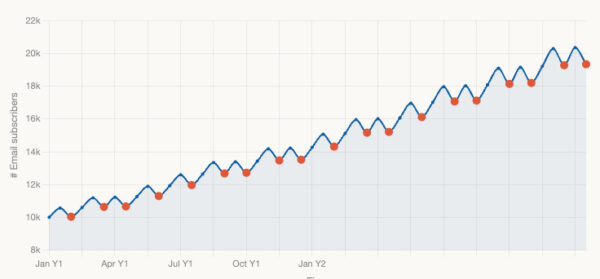
The result is what’s called a “sawtooth growth pattern” that looks like this:

This happens because when you send a fundraising email, some people on the list will look at it and think, “Oh, I don’t want to get these any longer” or “You know, I don’t care about this anymore.”  And so they unsubscribe.

These unsubscribes often cause people to panic.  However, they are a natural part of list building.

And if you only build your list but never ask anything of it, then you’re maximizing the wrong outcome: you’re optimizing “list size” instead of “money raised.”

The lesson here is that unsubscribes when you send out an e-appeal are natural.

They Didn’t Believe It

Yes you can.

I’ve written many times about how an organization’s beliefs about fundraising play a major role in how much money they can raise. 

Case in point:

“The ‘stories an organization tells itself’ about fundraising have a greater effect on how much money they raise than the stories they tell their donors.”

Well, I have a new one for you.

I just returned from the fantastic Elevate conference, which is focused on helping nonprofits use their events to raise more money and cause more connections. 

While at the conference, I had a conversation with a group of nonprofits who were extremely skeptical that they could raise money using the mail and email.  It was clear that these smaller, event-driven organizations did not believe that it was possible to communicate powerfully enough in a letter or email to inspire a person to give.

Here was my advice to them.  Don’t worry about the power of a letter or email to communicate your work.  Instead, believe in the power of how much a donor cares about what your organization is trying to accomplish. 

The donor’s desire to do something to help is so strong that a letter or email is all many donors need to send in a gift.

In the mail and email, you don’t need to convince donors.  You need to believe that they already care, then give them a timely invitation to help fund compelling work that’s happening soon.

Scary Data Frankensteins

Frankenstein.

When you are reviewing fundraising data, beware any time the data contains information from two different media channels or two different audiences. 

Here’s a simple example…

Say we recently completed a campaign that included one appeal letter to current donors and two e-appeals.  Here are the results:

  • 11,000 sent
  • 124 gifts
  • 1.4% response rate.

With those numbers, we can get a vague sense of whether the campaign was successful.  But I would say that the data above hides more than it illuminates because when we go to run the campaign next year we don’t know how to improve the campaign because we don’t know which parts of the campaign worked, and which parts didn’t.

But look at what happens when we can see the results for each piece of the campaign…

Direct mail appeal letter to current donors

  • 1,000 sent
  • 83 gifts
  • 8.3% response

E-appeal #1

  • 5,000 sent
  • 31 gifts
  • .62% response

E-Appeal #2

  • 5,000 sent
  • 10 gifts
  • .20% response

OK, now we’re talking.  Look at what we know now:

  • The appeal letter is a tremendous success.  An 8.3% response in direct mail is fantastic.
  • E-appeal #1 is also a success – a .62% response in email is also a success.
  • E-appeal #2 is not a success – a .2% response is too low.

Compare that to the combined data, which gave us an average response rate of 1.4%.  That number didn’t tell us anything.

But looking at the performance data for each piece enables us to do something powerful: learn that the messaging used in the appeal letter and e-appeal #1 worked great, and then apply those the next time we do this campaign and to all our future fundraising.

Additionally, by breaking out the results for each piece, over time you’ll learn your benchmarks for each audience and each channel.  This is very powerful because it helps you identify the pieces of fundraising that are effective, and those that aren’t.

But if you keep everything together, you just get a Frankenstein.

Direct mail and… Kale?

Kale.

Direct mail is like kale – nobody likes it the first time they try it.

Kale is a tough, leafy vegetable that tastes like a hedge.

But over time, a person can come to see the benefits of eating kale.  You start to appreciate kale.  And with the right prep and dressings, even enjoy it.

Direct mail is a tough, counter-intuitive, expensive way to raise money.

But over time, an organization can come to see the revenue that direct mail brings in and the relationship it builds.  You start to appreciate direct mail.  And with the right approach and understanding, even enjoy it.

Kale will never be as enjoyable as a cheeseburger.  Direct mail will never be as enjoyable as a great conversation with a major donor, or the emotional high of a beneficiary’s story at an event.

You might not like direct mail or kale.  But both of them are still good for you.

This post was originally published on February 6, 2024.